Ankle Sprains

An ankle sprain occurs when the ligaments that support the ankle joint are stretched or torn. Ligaments are strong bands of tissue that connect bones and help stabilize the joint.
Most ankle sprains occur when the foot rolls inward or outward suddenly, causing the ligaments to stretch beyond their normal range. This type of injury is very common and can occur during sports, exercise, walking on uneven surfaces, or simple missteps during daily activities.
SYMPTOMS
Common Symptoms of Ankle Fractures
Symptoms can vary depending on the severity of the ligament injury.
Pain around the ankle joint
Swelling that develops shortly after the injury
Bruising around the ankle or foot
Difficulty bearing weight on the affected foot
Limited range of motion or stiffness
In mild sprains, patients may still be able to walk. In more severe injuries, the ankle may feel unstable or too painful to put weight on.
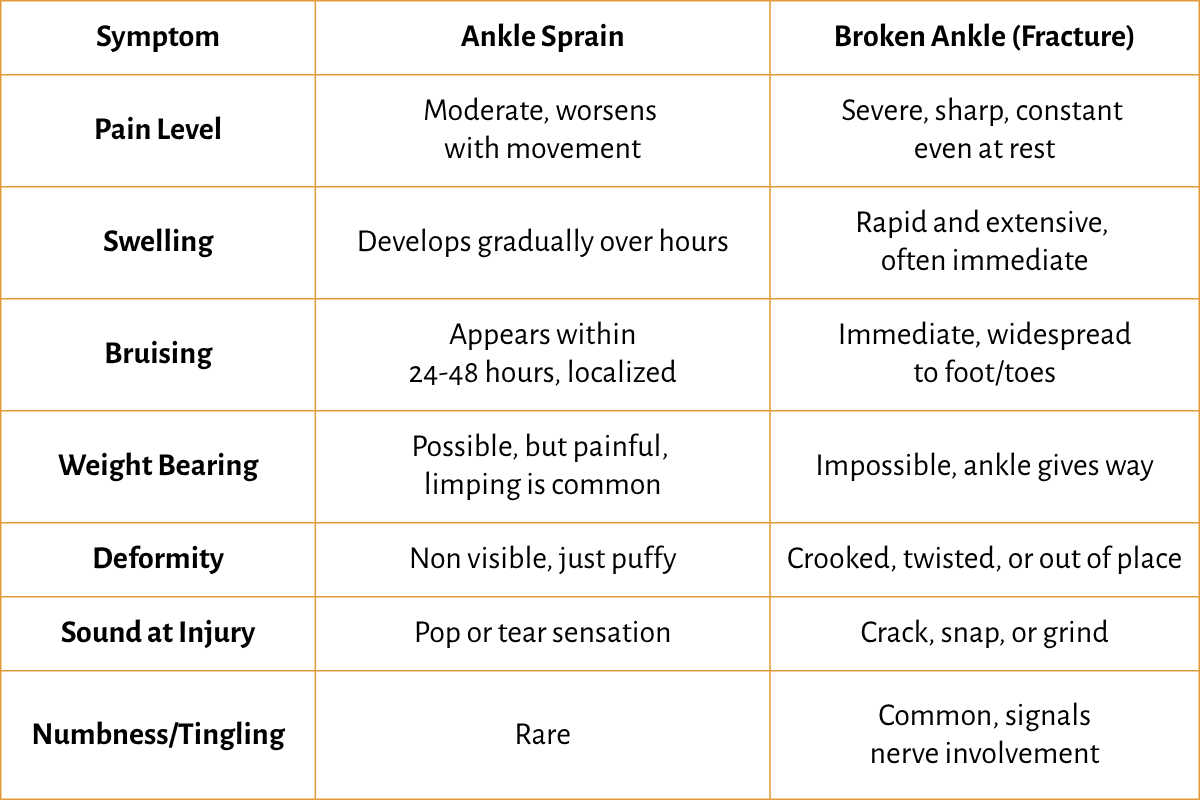
Sprained Ankle vs
Broken Ankle Symptoms
How do you know if your symptoms are due to a sprain or an ankle fracture?
DIAGNOSIS
Diagnosing Ankle Sprains
Diagnosis for a sprained ankle begins with a careful physical examination of the ankle joint which includes:
Assessment of swelling, tenderness, and range of motion
Testing ligament stability
Weight-bearing X-rays
X-rays are often used to rule out ankle fractures, since broken bones and sprains can cause similar symptoms. Ultrasound can be used to diagnose ligament tears or fraying. In some cases, MRI imaging may be recommended to evaluate ligament damage.
Types of Ankle Sprain
Ankle sprains are typically classified by severity.
Grade I (Mild Sprain)
Minor stretching of the ligament
Mild swelling and tenderness
Grade II (Moderate Sprain)
Partial tearing of the ligament
Increased swelling, bruising, and pain
Grade III (Severe Sprain)
Complete tear of the ligament
Significant swelling and joint instability
When to See an Expert?
RICE works for mild sprains, but if pain persists beyond 3-5 days, swelling worsens, or you can't bear weight, consult a podiatrist promptly for imaging to rule out fracture or severe ligament damage.
Early protection of the ankle helps prevent further injury while the ligaments heal.
Physical therapy is imperative for full rehabilitation. We work closely with physical therapists to assure dynamic rehabilitation that focuses on strengthening the surrounding muscle to help reduce the risk of future sprains.
TREATMENT
Ankle Sprains
Conservative Treatment
Most ankle sprains respond well to conservative treatment, which focuses on reducing swelling, protecting the ligaments, and allowing the joint to heal.
Common treatments include:
Immobilization with a brace or walking boot
Activity modification during the healing period
Is Surgery Needed?
Most ankle sprains heal successfully without surgery.
However, surgical treatment may be considered if:
The ligaments are severely torn
The ankle remains chronically unstable
Pain continues despite appropriate treatment
Surgery may involve repairing or reconstructing the damaged ligaments to restore stability to the ankle joint.

Early Treatment Helps Prevent Chronic Instability
Although ankle sprains are common — they should not be ignored.
Proper diagnosis and treatment can help ensure the ligaments heal correctly and reduce the risk of recurrent sprains or long-term ankle instability.
If you experience significant swelling, pain, or difficulty walking after an ankle injury, that is a sign to get it looked at by a podiatrist.
“
Got an appointment very quickly for a sports injury, needed an X-ray, which happened quickly in the office and we left with the orthotic supports we needed. It was a great experience overall!
— KATIE JO
Scientific Research
The epidemiology of ankle sprains in the United States
This study shows that ankle sprains are among the most common musculoskeletal injuries, affecting millions each year, particularly in sports and active populations. It also highlights that many sprains are undertreated, which increases the risk of chronic instability and long-term issues. The findings emphasize the importance of proper diagnosis and rehabilitation even for seemingly minor injuries.
Return to Play in Athletes Following Ankle Injuries
This review found that many athletes return to sport too early after an ankle sprain, increasing the risk of reinjury. It emphasizes that return-to-play decisions should be based on functional testing rather than time alone. Proper recovery and rehabilitation are key to preventing recurrence.
This study shows that patients who undergo supervised physical therapy tend to have better outcomes than those performing unsupervised home exercises. Structured rehab improves strength, balance, and return-to-activity rates. The results highlight the value of guided rehabilitation, particularly for more severe sprains.
This article suggests that repeated ankle sprains and chronic instability can increase the risk of developing ankle osteoarthritis over time. Even seemingly minor injuries may contribute to long-term joint degeneration. The findings reinforce the importance of proper treatment and prevention.
In the News