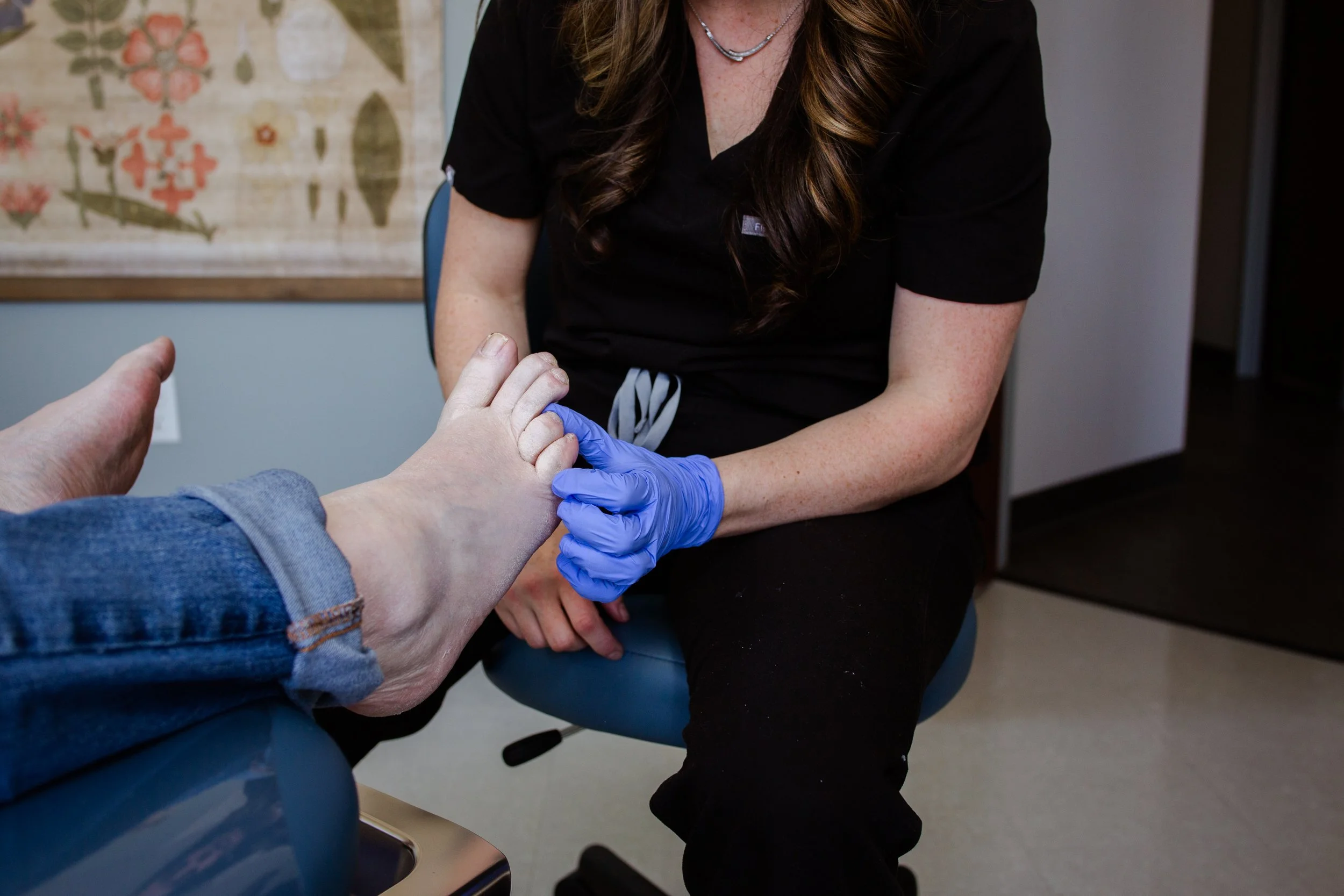
Hammertoes

Hammertoes are a condition where one or more of the toes become contracted or curl downward, causing a bent appearance.
CAUSES
What Causes Hammertoes?
Hammertoes can occur for several reasons, including:
Genetics or family history
Abnormal foot structure, such as high arches
Muscle imbalance or weakness
Trauma to the toe
The toes (except for the big toe) have two joints that allow movement. Either, or both, of these joints can become contracted, leading to the characteristic hammertoe shape.
Over time, these deformities can lead to corns on the tips, tops, or sides of the toes. Corns are thickened areas of skin that form as a protective response to friction or pressure from shoes. While corns can be treated, they do not correct the underlying toe deformity.
SYMPTOMS
Common Symptoms of Hammertoes
Patients with hammertoes may experience:
Pain or discomfort in several types of shoes
Corns or calluses on top or sides of the toes
Difficulty walking or irritation when wearing shoes
Visible curling or bending of the toes
Early evaluation is important to prevent worsening of the deformity and to manage pain effectively.
DIAGNOSIS
Diagnosing Hammertoes
Diagnosis typically includes:
A biomechanical exam of the foot to assess structure and toe movement
X-rays to evaluate the joints and severity of the deformity
Understanding whether the hammertoe is flexible, semi-rigid, or rigid helps guide treatment decisions.
TREATMENT
Hammertoes
Conservative Treatment
Many patients benefit from non-surgical management, which focuses on relieving pain and protecting the toes. Common treatments include:
Properly fitting shoes with a wide toe box
Padding or offloading devices to reduce pressure
Exercises to improve muscle balance and strength
Splints or toe caps to help reposition or support the toe
Removal of corns or calluses (removing corns is painless as it only involves dead skin)
While these treatments can reduce discomfort, they do not fix the toe deformity. To fix the deformity, surgery is needed.
Is Surgery Needed?
Surgical correction may be recommended if:
Conservative treatments fail to relieve pain
Pain interferes with daily activities or shoe wear
Surgical options vary depending on the severity and joint involvement. Procedures may include:
Tendon release to relax the muscles
Removing a small section of bone to straighten the toe
Fusion of toe joints for severe or rigid deformities
Recovery typically involves wearing a surgical shoe for about four weeks. Physical therapy or gradual return to activity may follow.

When to Consider Evaluation for Hammertoes
You should consider an evaluation if:
Your toes hurt in several types of shoes
You have corns on top or sides of your toes
Over-the-counter padding or shoe modifications do not relieve pain
Early evaluation can help manage symptoms, prevent worsening deformity, and determine whether surgery may be necessary. Call to make an appointment today!
Hammertoe Implant:
Stryker Smart Toe II
This is the implant our podiatrist recommends.
Stryker’s Smart Toe II is a premier, widely used intramedullary memory implant designed to correct hammertoe, mallet toe, and claw toe deformities. It features dynamic compression and rotational stability to promote high fusion rates (over 90%) while eliminating the need for external pins, providing a popular, effective alternative to K-wires. The nitinol (memory metal) implant compresses the joint, enhancing stability and promoting faster fusion.
Scientific Research
A 1-piece memory Nitinol intramedullary fixation device (Smart Toe; Stryker Corporation, Kalamazoo, MI) was used for proximal interphalangeal joint arthrodesis for correction of painful hammertoes in digits 2, 3, and 4. Sixty-five implants were placed in 35 patients. The mean age of the patients was 62.2 years and mean follow-up time was 27 months. Overall, a 93.8% fusion rate was noted. Complications were noted in 4 patients (6.1%): 1 asymptomatic nonunion (1.5%), 2 hardware failures (3%), and 1 implant displacement (1.5%). To date, no patients required revisional surgery or hardware removal.
This 2023 systematic review and meta-analysis compared K-wire fixation versus implant device fixation for hammertoe correction in 19 studies involving 1343 patients (3468 feet) for K-wire and 456 patients (664 feet) for implants. Both methods showed similar osseous union rates (71.3% for K-wire vs. 74.8% for implants), with no significant differences in complications (9.7% vs. 29.3%), failure rates (8.6% vs. 6.5%), or secondary surgeries (8.3% vs. 3.6%) per qualitative analysis
Hammertoes: Anatomy, Pathophysiology, and Comprehensive Treatment Strategies
This article, published in the Journal of the American Academy of Orthopaedic Surgeons on April 10, 2025, reviews hammertoe as a common foot deformity originating at the proximal interphalangeal joint. It details the anatomy and pathophysiology, emphasizing muscle-tendon imbalances that drive toe flexion, worsened by factors like tight shoes, genetics, trauma, or neuropathy. The article advocates conservative treatments first (padding, orthotics, stretches), escalating to surgical interventions like tendon transfers, arthrodesis, or arthroplasty for advanced rigid cases.
In the News